Deepfake Scams in Pakistan: When Seeing and Hearing Is No Longer Believing
By SAFer Legal & Security Consultant
Introduction
Artificial Intelligence (AI) has transformed many aspects of our lives, from improving healthcare to enhancing business productivity. Unfortunately, the same technology is also being exploited by cybercriminals to commit sophisticated fraud.
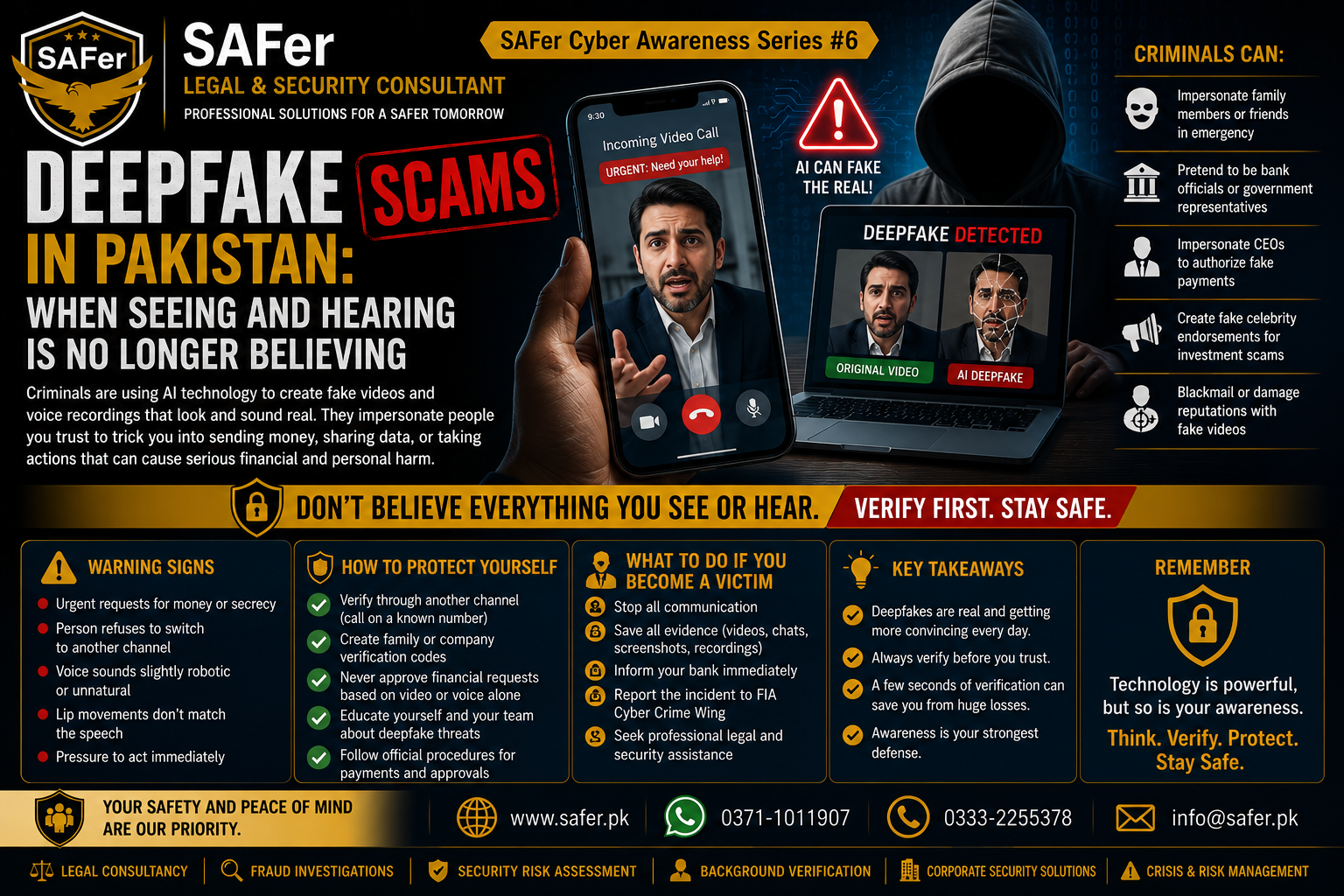
One of the most alarming developments is the rise of Deepfake Scams. Using AI-powered software, criminals can create highly convincing fake videos and voice recordings that appear to show real people saying or doing things they never actually did.
Imagine receiving a video call from someone who looks exactly like your son, daughter, employer, or business partner, urgently asking you to transfer money. Or hearing the voice of your company’s CEO instructing the finance department to make an immediate payment.
These are no longer scenes from science fiction—they are becoming real threats worldwide.
What is a Deepfake?
A deepfake is an image, video, or audio recording that has been artificially generated or manipulated using Artificial Intelligence (AI) to imitate a real person’s appearance or voice.
Modern AI tools can recreate facial expressions, lip movements, and speech patterns with remarkable accuracy, making fake content increasingly difficult to detect.
How Criminals Use Deepfakes
Cybercriminals are using deepfake technology to:
- Impersonate family members during emergencies.
- Pretend to be bank officials or government representatives.
- Imitate CEOs to authorize fraudulent payments.
- Create fake celebrity endorsements for investment scams.
- Produce fabricated videos to damage reputations or spread misinformation.
- Blackmail victims using manipulated videos.
Why Pakistan Should Be Concerned
As AI tools become more accessible, deepfake technology is expected to become a significant challenge for businesses, financial institutions, and individuals in Pakistan.
Criminals no longer need advanced technical expertise. Many AI applications now allow users to generate convincing voice or video content within minutes.
Warning Signs
Be cautious if:
🚩 Someone urgently requests money through a voice or video call.
🚩 The person refuses to continue the conversation through another verified communication channel.
🚩 The audio sounds slightly robotic or unnatural.
🚩 Lip movements do not perfectly match speech.
🚩 The caller creates pressure and insists on immediate action.
🚩 A public figure appears to endorse an unbelievable investment opportunity.
How to Protect Yourself
Verify Through Another Channel
If you receive an unusual request, contact the person using a known phone number before taking any action.
Create Family Verification Codes
Families and businesses can establish confidential code words for emergencies.
Verify Financial Requests
Never approve financial transactions solely based on a voice or video message.
Educate Employees
Organizations should train staff to recognize AI-generated fraud and implement approval procedures for financial transactions.
Stay Updated
Follow trusted sources for information on emerging cyber threats and fraud techniques.
Real-Life Scenario
A finance manager receives a video call appearing to be from the company’s Managing Director, requesting an urgent transfer to finalize an overseas contract. The voice, face, and mannerisms all seem authentic.
Before processing the payment, the manager follows company policy and calls the Managing Director using his official mobile number. He discovers that the video call was a sophisticated AI-generated deepfake.
Because of a simple verification step, the company avoids a substantial financial loss.
What Should You Do If You Become a Victim?
- Stop all further communication.
- Preserve videos, audio recordings, screenshots, and chat messages.
- Notify your bank immediately if money has been transferred.
- Change passwords if personal information has been compromised.
- Report the incident to the relevant cybercrime authorities.
- Seek professional legal and investigative assistance.
Key Takeaways
✔ AI-generated scams are becoming more convincing.
✔ Never trust urgent financial requests without independent verification.
✔ Verify voice and video calls through official contact numbers.
✔ Organizations should establish clear payment approval procedures.
✔ Awareness is the strongest defense against emerging cyber threats.
Conclusion
Technology continues to evolve, and so do the methods used by cybercriminals. Deepfake scams represent a new generation of fraud that relies on deception rather than hacking.
The good news is that awareness, verification, and sound security practices remain effective defenses. Before acting on any urgent request, take a moment to verify the information through trusted channels.
Remember:
Don’t Believe Everything You See or Hear—Verify First.
Need Professional Legal or Security Assistance?
If you or your organization requires assistance with cyber fraud investigations, legal consultancy, corporate security, internal inquiries, or risk management, contact:
SAFer Legal & Security Consultant
Professional Solutions for a Safer Tomorrow
🌐 Website: www.safer.pk
💬 WhatsApp: 0371-1011907
📞 Call: 0333-2255378
📧 Email: info@safer.pk
Our Services
⚖️ Legal Consultancy
🛡️ Security Risk Assessment
🔎 Fraud & Corporate Investigations
📋 Internal Inquiries
🏢 Corporate Security Solutions
👤 Background Verification
📑 Due Diligence
🚨 Crisis & Risk Management
Protect Your Identity. Protect Your Business. Trust SAFer.