Beware of Fake E-Challan Scams in Karachi Don’t Let a Fake Traffic Fine Cost You More Than Money
By: SAFer Legal & Security Consultant
Introduction
Karachi has recently adopted a modern Faceless E-Challan System (TRACS) to improve traffic law enforcement. Genuine traffic violations are recorded through intelligent surveillance cameras and processed electronically.
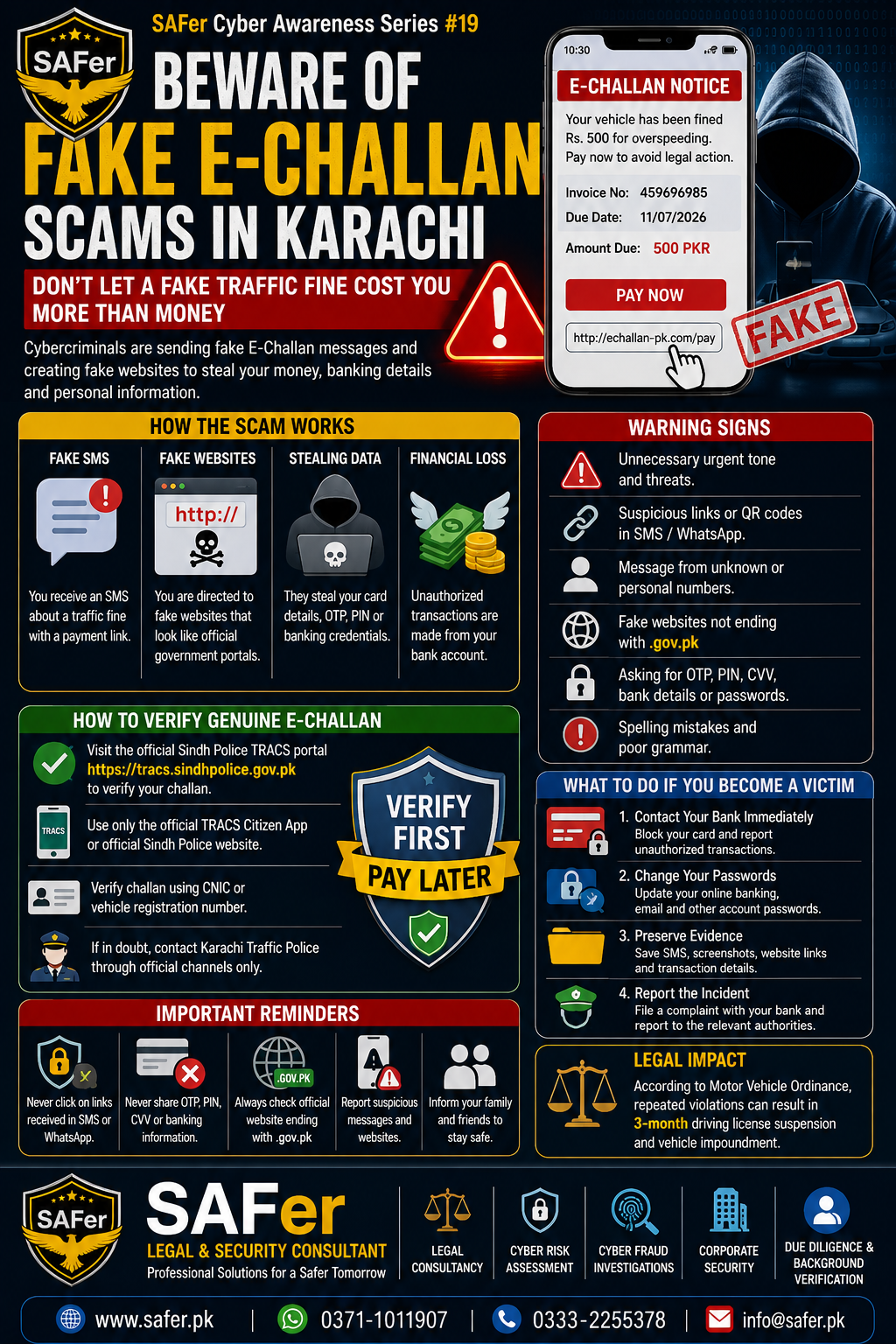
Unfortunately, cybercriminals have begun exploiting public awareness of this system by sending fake E-Challan SMS messages, WhatsApp messages, and links to fraudulent websites that closely resemble official government portals. Their objective is to steal your money, banking credentials, card details, or personal information. (TRACS)
Remember: Receiving an E-Challan message does not automatically mean it is genuine.
What is the Fake E-Challan Scam?
In this scam, criminals impersonate the Karachi Traffic Police or Sindh Police and send messages claiming that your vehicle has violated traffic laws.
These messages often include:
- A fake E-Challan number
- Vehicle registration details
- A payment deadline
- A threat of licence suspension or vehicle impoundment
- A payment link or QR code
The goal is to pressure victims into making immediate payments or revealing sensitive information.
How the Scam Works
1. Fake SMS Messages
Victims receive messages such as:
“Your vehicle has been fined Rs. 500 for overspeeding. Pay immediately to avoid legal action.”
A suspicious payment link is attached.
2. Fake Websites
Fraudsters create websites that imitate the appearance of official Sindh Police pages.
They ask users to enter:
- CNIC
- Mobile Number
- Debit/Credit Card Details
- Banking Credentials
- OTP Codes
Once entered, the information is stolen.
3. Fake WhatsApp Messages
Some victims receive WhatsApp messages containing:
- Fake challan screenshots
- QR Codes
- Payment links
- APK files disguised as official applications
4. Fake Phone Calls
Criminals call victims pretending to be:
- Traffic Police Officers
- Bank Officials
- Government Representatives
They demand immediate payment and threaten legal consequences if payment is delayed.
Warning Signs
Be cautious if:
🚩 The message creates unnecessary panic.
🚩 You’re asked to pay immediately through a link.
🚩 The sender uses a personal mobile number.
🚩 The website address is not an official government domain.
🚩 You are asked for your OTP, ATM PIN, or banking password.
🚩 The message contains spelling or grammatical mistakes.
How to Verify a Genuine E-Challan
Before making any payment:
✔ Visit the official Sindh Police TRACS portal.
✔ Verify the challan using your CNIC or vehicle registration number.
✔ Use only the official TRACS Citizen App or the official Sindh Police website.
✔ If in doubt, contact the Karachi Traffic Police through official channels. (TRACS)
How to Protect Yourself
Never Click Unknown Links
Always type the official website address yourself instead of using links received in messages.
Never Share Banking Information
Never disclose:
- ATM PIN
- Debit/Credit Card Number
- CVV
- OTP
- Internet Banking Password
No legitimate authority will ask for these details to verify or pay an E-Challan.
Check the Website Carefully
Official government websites usually end with:
.gov.pk
Be cautious of domains that imitate official names.
Verify Before Paying
If you receive an unexpected E-Challan, confirm it through the official portal before making any payment.
Report Suspicious Messages
Report fake SMS messages, WhatsApp messages, or fraudulent websites to the relevant authorities and avoid forwarding them to others.
Real-Life Scenario
Mr. Ahmed received an SMS stating that his car had been fined Rs. 500 for overspeeding.
The message warned that failure to pay within 24 hours would result in suspension of his driving licence.
He clicked the payment link and was redirected to a website that closely resembled the official E-Challan portal.
After entering his debit card details and OTP, unauthorized transactions were made from his bank account.
Had he verified the challan through the official TRACS portal first, he could have avoided becoming a victim.
What Should You Do If You Become a Victim?
1. Contact Your Bank Immediately
Request that your debit or credit card be blocked if financial information was shared.
2. Change Your Passwords
Immediately update your online banking and email passwords from a trusted device.
3. Preserve Evidence
Save:
- SMS messages
- WhatsApp chats
- Screenshots
- Website links
- Transaction receipts
4. Report the Incident
Report the fraud to your bank and the relevant cybercrime authorities.
5. Warn Others
Inform family members and friends so they do not fall victim to the same scam.
Key Takeaways
✔ Verify every E-Challan through official government channels.
✔ Never pay through suspicious links.
✔ Never share your OTP, PIN, or banking credentials.
✔ Check that websites use official .gov.pk domains.
✔ Report suspicious messages immediately.
Conclusion
Cybercriminals rely on fear and urgency to deceive people. A genuine traffic fine may cost a few hundred rupees—but a fake E-Challan scam could cost you your savings and personal information.
Remember: Verify First. Pay Later. Stay SAFer.