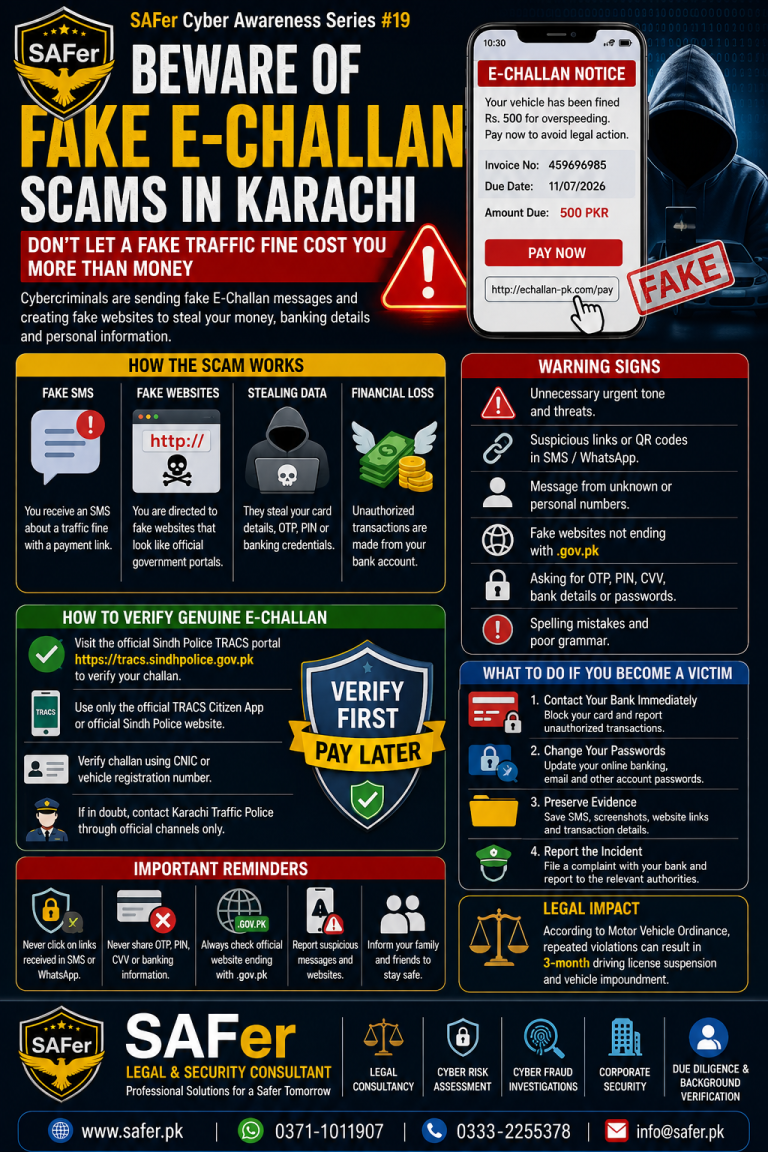
Digital Payment Fraud in Pakistan: Protect Your Money in a Cashless World
By SAFer Legal & Security Consultant
Introduction
Pakistan is rapidly embracing digital financial services. Mobile wallets, internet banking, QR payments, debit cards, and instant fund transfers have made financial transactions faster and more convenient than ever before.
However, this digital transformation has also created new opportunities for cybercriminals. Fraudsters are continuously developing sophisticated methods to steal money through fake banking calls, phishing websites, malicious mobile applications, and social engineering.
Whether you use mobile banking, Easypaisa, JazzCash, debit cards, or internet banking, understanding digital payment fraud is essential to protecting your finances.
What is Digital Payment Fraud?
Digital payment fraud occurs when criminals illegally obtain access to a person’s financial information or digital payment accounts to steal money or conduct unauthorized transactions.
Common targets include:
- Mobile Wallets
- Internet Banking
- Debit Cards
- Credit Cards
- QR Payments
- Online Banking Apps
- Payment Gateway Accounts
Common Digital Payment Scams
1. Fake Bank Representative Calls
Criminals pretend to be bank officials and request:
- ATM PIN
- OTP
- Debit Card Number
- CVV Code
- Internet Banking Password
Remember:
No legitimate bank employee will ever ask for your PIN or OTP.
2. Fake Payment Screenshots
Fraudsters send edited screenshots claiming payment has been made.
Always verify payment through your own banking application before releasing goods or services.
3. Fake Banking Applications
Cybercriminals create fake banking apps that steal login credentials.
Only download applications from official app stores and verify the publisher.
4. QR Code Payment Fraud
Instead of receiving money, victims unknowingly authorize payments by scanning fraudulent QR codes.
Always understand what a QR code is requesting before scanning it.
5. OTP Fraud
Fraudsters manipulate victims into sharing One-Time Passwords by creating false urgency.
An OTP is your digital signature—never share it with anyone.
Warning Signs
Be cautious if:
🚩 Someone asks for your banking PIN or OTP.
🚩 You receive calls claiming your account will be blocked immediately.
🚩 Unknown apps request banking permissions.
🚩 You are pressured to transfer money quickly.
🚩 A buyer refuses normal payment verification.
🚩 Messages contain suspicious links.
How to Protect Yourself
Never Share Banking Credentials
Keep confidential:
- ATM PIN
- OTP
- CVV
- Passwords
- Mobile Banking Login
Verify Every Transaction
Always check your own bank statement before confirming payment.
Enable Banking Alerts
SMS and app notifications allow immediate detection of unauthorized activity.
Download Only Official Banking Apps
Avoid third-party download websites.
Secure Your Smartphone
Use:
- Screen Lock
- Fingerprint Authentication
- Face Recognition
- Regular Software Updates
Monitor Bank Statements
Review transactions regularly and immediately report suspicious activity.
Real-Life Scenario
Mr. Hassan advertised his motorcycle for sale online. A buyer claimed to have transferred the payment and sent a professional-looking payment screenshot through WhatsApp.
Without checking his bank account, Mr. Hassan handed over the motorcycle. Later, he discovered the payment screenshot had been digitally altered and no funds had actually been transferred.
Although fictionalized to protect privacy, similar scams have affected many online sellers.
What Should You Do If You Become a Victim?
1. Contact Your Bank Immediately
Request that suspicious transactions be investigated.
2. Block Your Cards
If card information may have been compromised, request immediate blocking and replacement.
3. Preserve Evidence
Save:
- Chat history
- Payment screenshots
- Call recordings (if available)
- Bank notifications
- Phone numbers
- Transaction receipts
4. Change Banking Passwords
Update passwords from a secure device.
5. Report the Incident
Report fraudulent activity to the relevant financial institution and cybercrime authorities.
6. Seek Professional Assistance
Early legal and investigative advice can help preserve evidence and support recovery efforts where possible.
Key Takeaways
✔ Never share OTPs, PINs, or banking passwords.
✔ Verify payments through your own banking app.
✔ Download banking apps only from official sources.
✔ Enable transaction alerts.
✔ Be cautious of urgent requests.
✔ Awareness prevents financial loss.
Conclusion
Digital payments have made life easier, but convenience should never replace caution. Cybercriminals depend on trust, urgency, and human error to succeed.
Before approving any transaction, verify it independently. A few seconds of verification can prevent significant financial loss.
Remember: Verify Every Payment Before You Trust It.
Need Professional Legal or Security Assistance?
If you have experienced digital payment fraud, banking scams, cybercrime, identity theft, or require professional legal and security guidance, contact:
SAFer Legal & Security Consultant
Professional Solutions for a Safer Tomorrow
🌐 Website: www.safer.pk
💬 WhatsApp: 0371-1011907
📞 Call: 0333-2255378
📧 Email: info@safer.pk
Our Professional Services
⚖️ Legal Consultancy
🛡️ Cyber Risk Assessment
🔎 Fraud & Digital Investigations
📋 Internal Inquiries
🏢 Corporate Security Solutions
👤 Employee Background Verification
📑 Due Diligence Services
🚨 Crisis & Incident Management
Protect Your Money. Protect Your Identity. Stay SAFer.