Beware of Fake WhatsApp Calls and Messages: How to Protect Yourself from Online Scams By: SAFer Legal & Security Consultant.
Introduction:
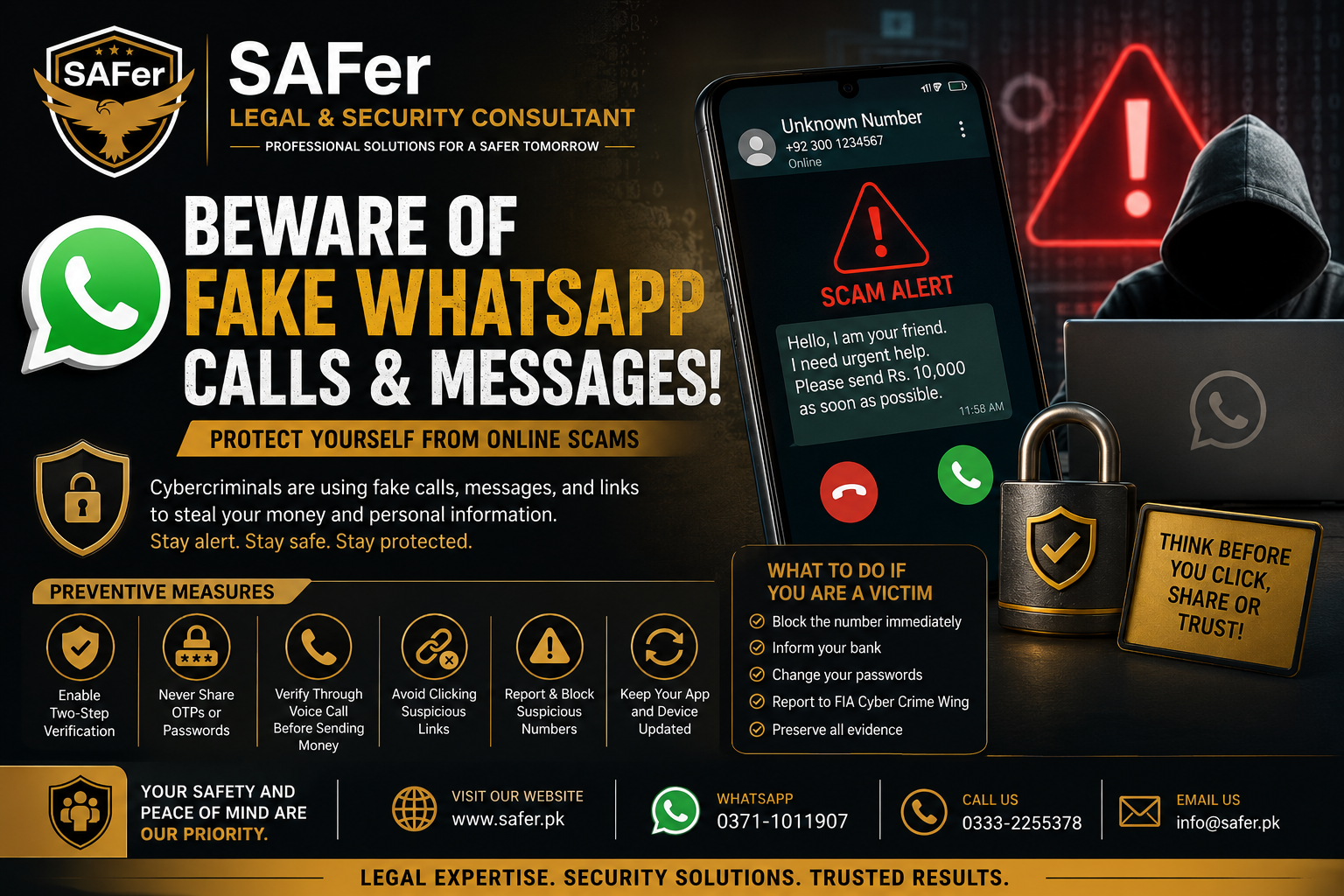
WhatsApp has become an indispensable communication tool in Pakistan, connecting millions of users daily. Unfortunately, cybercriminals are increasingly exploiting this platform to deceive innocent people through fake calls, impersonation, malicious links, and fraudulent messages. Many victims lose money or compromise their personal information because they are unaware of the tactics employed by these scammers.
Understanding how these scams operate and adopting preventive measures can significantly reduce the risk of becoming a victim.
Common WhatsApp Scams in Pakistan
- Impersonation Scam
Fraudsters create fake accounts using the photographs and names of relatives, friends, or colleagues. They then contact victims, claiming to be in an emergency and requesting money.
- OTP Verification Scam
Scammers pretend to be representatives from WhatsApp, banks, or courier companies and ask users to share One-Time Passwords (OTP). Once obtained, they can gain access to accounts or financial information.
- Malicious Links
Victims receive messages containing links promising rewards, government aid, free internet packages, or job opportunities. Clicking such links can compromise personal data or install malware.
- International Unknown Calls
Calls from unfamiliar international numbers are often attempts to lure users into scams or to verify active numbers for future fraudulent activities.
- QR Code Fraud
Cybercriminals persuade victims to scan QR codes under false pretenses. Instead of receiving money, victims may unknowingly authorize payments from their accounts.
Warning Signs
Be cautious if you notice:
✅ Requests for urgent financial assistance.
✅ Messages asking you not to tell anyone.
✅ Unknown international numbers.
✅ Suspicious links or attachments.
✅ Requests for OTPs, passwords, or PIN codes.
✅ Offers that appear too good to be true.
Preventive Measures
Enable Two-Step Verification
Activate WhatsApp’s two-step verification feature to provide an additional layer of security.
Never Share OTPs
Legitimate organizations and banks never ask for OTPs or passwords through WhatsApp.
Verify Before Sending Money
Always call the person directly through their known number before transferring money.
Avoid Suspicious Links
Do not click on unfamiliar links or download unknown files.
Update Your Applications
Regularly update WhatsApp and your mobile device to ensure security vulnerabilities are patched.
Block and Report Scammers
Use WhatsApp’s built-in “Block” and “Report” functions to help protect others.
What To Do If You Become a Victim
Immediately block the fraudulent number.
Inform your bank if financial information has been compromised.
Change passwords and enable two-factor authentication.
Preserve screenshots and all evidence.
Report the matter to the FIA Cyber Crime Wing through the National Cyber Crime Reporting Portal.
Seek professional legal and investigative assistance if financial loss or identity theft has occurred.
Key Takeaways
✔ Verify every request for money.
✔ Never share OTPs or passwords.
✔ Avoid clicking suspicious links.
✔ Enable two-step verification.
✔ Report scams immediately.
✔ Stay informed and educate family members, especially elderly persons.
Conclusion:
Awareness remains the strongest defense against cybercrime. As scammers become increasingly sophisticated, individuals must adopt safe online practices and remain vigilant. A few moments of caution can prevent financial losses and protect your digital identity.
Need Professional Legal or Security Assistance?
Whether you are facing cyber fraud, employee misconduct, internal theft, security concerns, or require legal guidance, SAFer Legal & Security Consultant is committed to providing practical, confidential, and professional solutions.
🔐 SAFer Legal & Security Consultant
Professional Solutions for a Safer Tomorrow
💬 WhatsApp: +92-371-1011907
📞 Call: +92-333-2255378
⚖️ Legal Consultancy | 🛡 Security Solutions | 🔎 Investigations | 📋 Internal Inquiries | 🚨 Risk Management